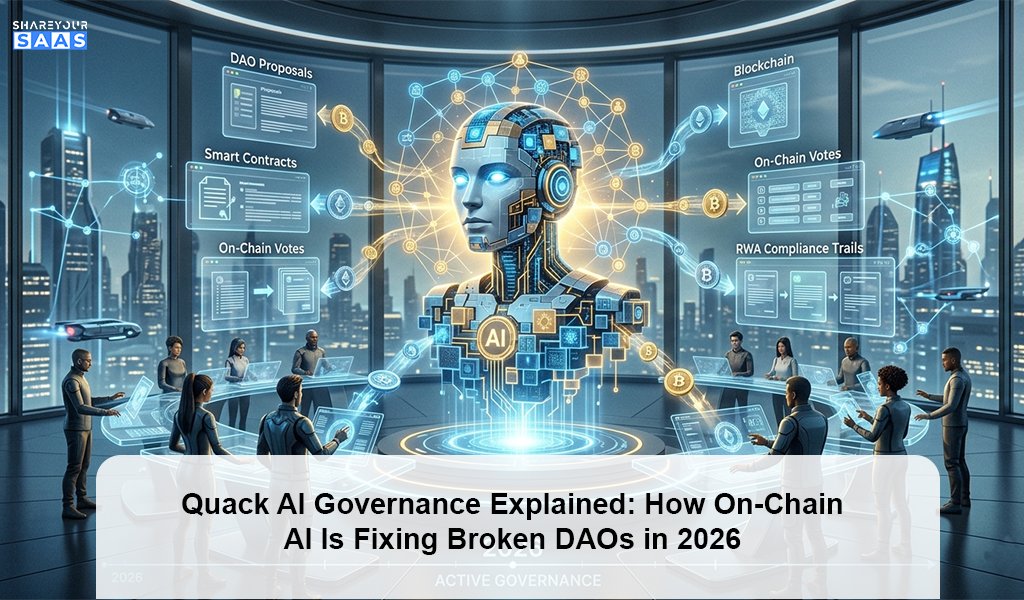
Imagine if you owned a piece of a massive digital company but were too busy to read 50-page technical proposals or track Discord chats 24/7. This is the reality for most DAO token holders in 2026—they have the power to vote, but not the time to study. This is where Quack AI governance steps in.
Quack AI governance is the world’s first AI-powered, on-chain governance protocol that automates DAO decision-making — replacing slow, manipulation-prone voting with real-time AI agents. If you’ve ever wondered why decentralized governance feels neither decentralized nor effective, this is where the answer lives.
What Is Quack AI Governance?
Let’s be direct.
Quack AI governance is a protocol that puts AI agents in charge of analyzing proposals, monitoring risks, and executing votes across multiple blockchains — without needing humans to manually show up for every decision.
The token is $AIQ. The mission is simple: fix the mess that DAO governance has become.
Built initially on DuckChain (a TON Layer 2 network by TONSCALE Labs), it has since expanded to MANTRA’s EVM mainnet, Ethereum, Solana, BNB Chain, and more. As of 2026, it has attracted over 2 million Governance Passport users, integrated with 40+ blockchain projects, and raised $3.6 million from institutional backers including Animoca Brands, Kenetic Capital, and Skyland Ventures.
That’s not hype. That’s traction.
The Real Problem with DAO Governance (And Why It Matters)
Here’s something most people don’t realize: the average voter turnout across major DAOs sits below 8%.
Think about that. A system built on community decision-making is actually controlled by a handful of whales and founding teams.
The problems are predictable once you see them:
- Most token holders don’t vote because they either forget or don’t understand the proposal
- Governance decisions can take days or weeks — by which time market conditions have already shifted
- Large wallet holders dominate votes, creating exactly the kind of power concentration blockchain was supposed to eliminate
- There’s no real risk monitoring — proposals get passed without anyone stress-testing the financial exposure
This is where most DAO protocols have failed. They built the voting infrastructure but forgot to make it actually work for real people. Quack AI addresses this gap head-on.
How Quack AI On-Chain Governance Actually Works
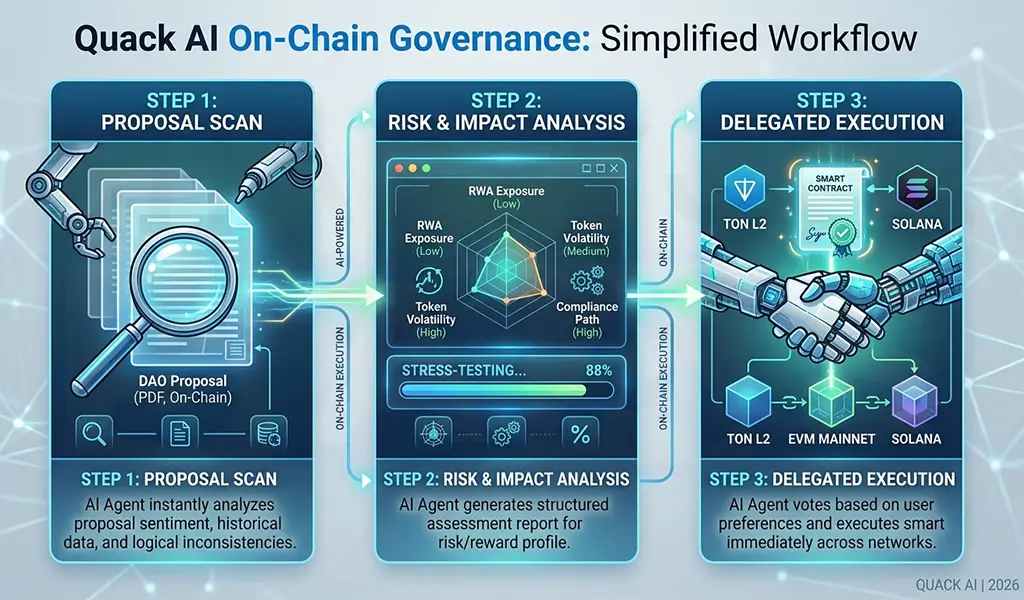
This is the part worth understanding deeply.
AI Proposal Analysis
Every time a proposal gets submitted to a Quack AI-integrated DAO, an AI agent immediately starts working. It analyzes community sentiment, historical voting patterns, real-time on-chain data, and the risk profile of the proposal itself.
The result? A structured evaluation report — not a PDF buried in Discord, but an automatically generated, on-chain assessment that any token holder can read before voting.
Delegated Agent Voting
If you don’t want to vote manually (and most people don’t), you can delegate to an AI agent that reflects your governance preferences. The agent votes on your behalf — informed, active, and consistent.
This is what the Governance Passport enables. It transforms your wallet from a passive holder into an active governance participant without requiring you to understand every technical detail of every proposal.
Cross-Chain Execution
One of the more underrated features of quack ai on-chain governance is its cross-chain reach.
Most governance tools only work within one blockchain. Quack AI operates across EVM networks, TON, Solana, and others. A DAO running on Ethereum can benefit from the same governance infrastructure as one on BNB Chain. Proposals get executed automatically via cross-chain smart contracts — no manual intervention, no delays.
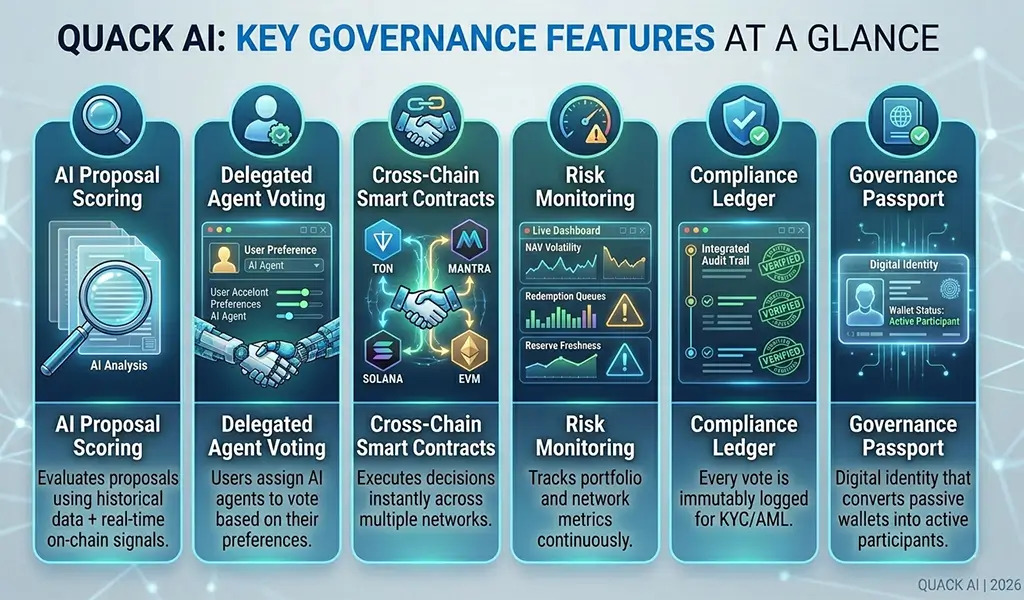
Key Features at a Glance
| Feature | What It Does |
| AI Proposal Scoring | Evaluates proposals using historical data + real-time on-chain signals |
| Delegated Agent Voting | Users assign AI agents to vote based on their preferences |
| Cross-Chain Smart Contracts | Executes decisions instantly across multiple networks |
| Risk Monitoring | Tracks NAV volatility, redemption queues, proof of reserve freshness |
| Compliance Ledger | Every vote is immutably logged and exportable for KYC/AML needs |
| Governance Passport | Digital identity that converts passive wallets into active participants |
Real-World Example: MANTRA × Quack AI
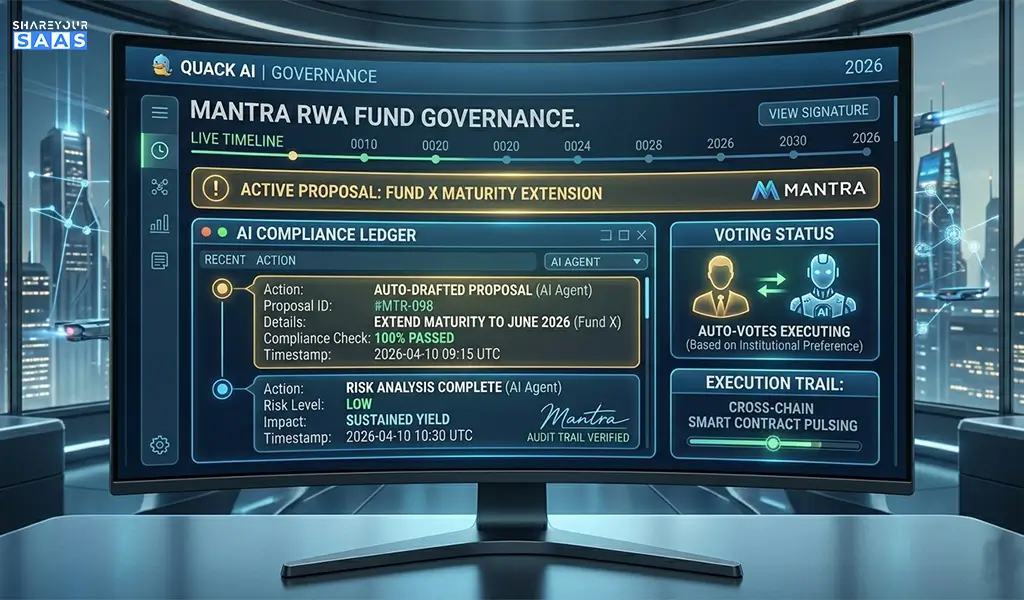
Want proof this isn’t theoretical?
In 2025, Quack AI went live on MANTRA’s EVM mainnet — one of the most compliance-focused Real World Asset (RWA) blockchains in existence. That deployment is now battle-tested heading into 2026, and the lessons from it are shaping how other RWA protocols think about governance.
The use case is concrete. Asset issuers on MANTRA used to manage governance through emailed PDFs and manual coordination. Now, a fund extension proposal — something like “Approve extension of Fund X maturity to June 2026” — gets auto-drafted by an AI agent based on incoming disclosure data, posted on-chain, analyzed for investor impact, and executed with a full compliance trail.
That’s not just faster. It’s a fundamentally different category of governance.
For institutional adoption of RWAs, this kind of auditability is non-negotiable. Quack AI delivers it without adding operational burden.
Fact Check: Is Quack AI Legit?
This is the section most articles skip. Let’s not.
Verified facts:
- $3.6M funding round — confirmed by public announcements from Animoca Brands and Kenetic Capital
- Listed on Binance in 2025 — publicly verifiable, and still active in 2026
- 2M+ Governance Passport users — reported via Chaincatcher
- Live on MANTRA EVM mainnet — confirmed by MANTRA’s official announcement page
- Backed by DuckChain ecological grant — confirmed in official Quack AI documentation
What to watch out for:
- The $AIQ token is a speculative crypto asset. Price predictions floating online are not financial advice and have no grounding in guaranteed outcomes
- Quack AI is not fully autonomous — human override is always possible and intentional by design
- Like any protocol this early, smart contract vulnerabilities remain a category of risk
The project has real partnerships, real institutional backing, and real users. That separates it from the majority of governance theater that populates the Web3 space. Still — do your own research before investing.
Personal Take: Why This Architecture Makes Sense
I’ve watched DAO governance stall dozens of projects over the past few years. The pattern is always the same: a small group gets fatigued, stops showing up, and the protocol drifts.
Quack AI’s approach is architecturally sound because it solves the participation problem, not just the efficiency problem. Most governance tools optimize for speed. Quack AI recognizes that the real bottleneck is the gap between people who hold tokens and people who want to actively shape the protocol.
The Governance Passport — a digital identity that activates your wallet as a governance participant — is the most practically useful innovation here. It doesn’t require you to become a governance expert. It just requires you to set your preferences once. The AI handles the rest.
That said, the multi-chain expansion will be the real test. Cross-chain governance is technically complex, and execution risk compounds with every new network integration.
What This Means If You’re Building or Investing in Web3
If you’re a DAO founder: Quack AI gives you governance infrastructure that doesn’t collapse at scale. You’re not relying on your community to show up manually for every vote.
If you’re an RWA protocol: The compliance ledger and automated proposal generation are worth serious evaluation. Institutional investors need auditability — Quack AI builds it in from the start.
If you’re an investor: The AI-driven governance market is growing fast. The AI software market was valued at $122 billion in 2024 and is projected to reach $467 billion by 2030. In 2026, Quack AI sits at the intersection of two of the fastest-growing categories in tech right now.
If you’re just curious about Web3: This is a good protocol to watch because it’s solving a real, observable problem — not inventing a problem to justify a token.
For more on how AI tools are reshaping the tech stack for startups and builders, check out The Best AI SaaS Tools for Small Startups in 2026 and explore more Fintech and Technology coverage on ShareYourSaaS.
External resources worth bookmarking:
- Quack AI Official Documentation — The most accurate source for technical details
- MANTRA × Quack AI Announcement — Real-world deployment case study
Conclusion
For more explainers like this, browse our SaaS reviews hub.
Quack AI governance is not a concept paper — it has live deployments, institutional funding, and millions of users. The on-chain AI governance model it introduces genuinely addresses the participation and manipulation problems that have plagued DAOs since their inception. Whether you’re building, investing, or just paying attention to where Web3 is heading, this protocol deserves a serious look.
FAQ
Q1: What is Quack AI governance in simple terms?
Quack AI governance is a protocol that uses AI agents to analyze, vote on, and execute DAO proposals automatically — making decentralized governance faster, fairer, and more accessible without requiring manual participation from every token holder.
Q2: What is quack ai on-chain governance?
Quack AI on-chain governance means all actions — proposal analysis, voting, execution, and compliance logging — happen directly on the blockchain. Every step is transparent, immutable, and verifiable without trusting any central party.
Q3: Is Quack AI ($AIQ) a good investment?
Quack AI has strong institutional backing ($3.6M from Animoca Brands and others), a Binance listing, and real adoption across 40+ projects. However, $AIQ is a volatile crypto asset. No price prediction is guaranteed — evaluate the fundamentals and your own risk tolerance before investing.
Q4: How does Quack AI differ from traditional DAO governance tools?
Traditional DAO tools handle only voting. Quack AI handles the full governance lifecycle — proposal generation from raw disclosures, AI risk analysis, delegated voting via AI agents, cross-chain execution, and a compliant audit trail. It’s infrastructure, not just a voting button.
Q5: Which blockchains does Quack AI support?
Quack AI currently supports EVM-compatible chains (including MANTRA, BNB Chain, Linea, Metis, Taiko), TON (via DuckChain), Ethereum, and Solana — with ongoing multi-chain expansion continuing through 2026 as part of its four-phase roadmap.