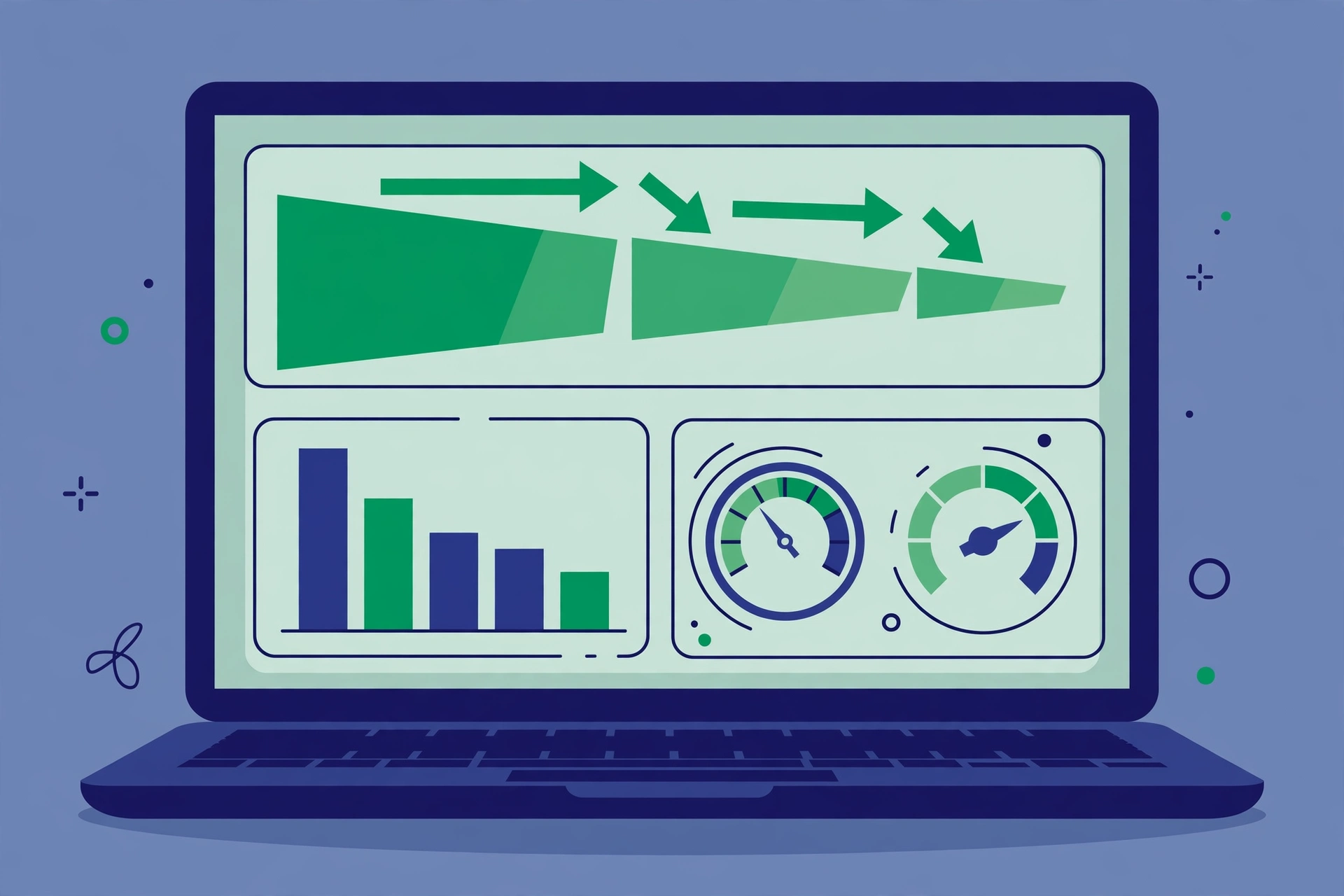
A SaaS marketing funnel is the journey a buyer takes from first hearing about your software to becoming a paying — and staying — subscriber. It looks like a traditional marketing funnel at the top, but it’s built for a different business model: subscriptions. In SaaS, closing the sale is the starting line, not the finish. If your average customer stays four months but your acquisition cost takes six months to recover, you’re losing money on every signup. This guide breaks down the 7 stages of the SaaS marketing funnel, the metrics that matter at each one, and how to fix the leaks that quietly drain growth.
What is a SaaS marketing funnel, exactly?
A SaaS marketing funnel is a framework that maps how a potential customer moves from discovering your product to purchasing it — and, crucially, what happens after purchase. The classic version has four layers: top of funnel (awareness), middle (consideration), bottom (conversion), and retention. The SaaS-specific version extends further, because subscription revenue depends on customers who stay, expand, and advocate.
Three things make it different from a traditional funnel:
- Retention is a marketing job, not just a product job. In e-commerce, the funnel ends at checkout. In SaaS, most of a customer’s lifetime value can come after the first payment — through renewals, upsells, and referrals. Marketing that stops at conversion leaves most of the money on the table.
- Free trials and freemium change the middle. Prospects don’t just read about your product; they use it before paying. That means your funnel has an “activation” moment — the point where a trial user experiences real value — and everything before it exists to drive toward that moment.
- The funnel isn’t linear. Buyers sign up for a trial, go quiet for three weeks, compare you against two competitors, then convert. Google calls this the “messy middle” — a loop of exploration and evaluation. Your funnel has to handle looping, not just straight-line flow.
The 7 stages of the SaaS marketing funnel
Stage 1: Awareness — be findable where buyers look
At the top, buyers don’t know you exist. They know they have a problem (“our invoices are a mess”) and they’re searching for answers. Your job: show up with genuinely useful content that addresses the pain, not your product. Blog posts, SEO guides, YouTube explainers, and community answers (Reddit threads increasingly get cited by AI answer engines) all work here.
Metric that matters: qualified traffic and share of voice for problem-aware keywords — not raw pageviews. A thousand visitors with buying intent beat a hundred thousand casual readers.
Stage 2: Engagement — earn attention with instant value
Awareness without engagement is just impressions. This is where you convert a passerby into someone who interacts: an email signup, a downloaded template, a churn calculator they actually use. Generic newsletters don’t cut it anymore — offer something specific and immediately useful, like a pricing calculator or a teardown of how a similar company solved the problem.
Metric that matters: engagement rate — email signups, content downloads, return visits. If awareness is growing but engagement is flat, your top-of-funnel content is attracting the wrong people.
Stage 3: Consideration — help them compare (honestly)
Now they know they need software and they’re comparing options — you against two or three competitors. This is where comparison pages, case studies, ROI calculators, and live demos earn their keep. The counterintuitive move that works: be honest about where competitors are better. Buyers in 2026 are allergic to one-sided “why we’re the best” pages; a candid comparison builds the trust that closes deals.
Metric that matters: demo/trial request rate and sales-qualified lead (SQL) volume.
Stage 4: Conversion — remove friction, not just add urgency
When trial users stall at the paywall, the problem usually isn’t motivation — it’s friction. Confusing pricing tiers, a checkout that asks for too much, a credit card required for a “free” trial. Audit your conversion path like a skeptic: count the clicks from “start trial” to “paid”, read every pricing-page sentence out loud, and kill anything that creates doubt.
Metric that matters: trial-to-paid conversion rate. For self-serve SaaS, 15–25% is a healthy benchmark band; below 10%, you have a friction problem, not a traffic problem.
Stage 5: Retention — the true battleground
This is where SaaS funnels are won or lost. A 10% improvement in retention is almost always more profitable than doubling your traffic. Watch for “silent churn” — logins dropping off, feature usage narrowing — before the cancellation email ever arrives. Onboarding emails, in-app guidance, and proactive check-ins at the 30/60/90-day marks are the standard toolkit.
Metric that matters: net revenue retention (NRR). Above 100% means expansion revenue outpaces churn — the hallmark of a healthy SaaS business.
Stage 6: Expansion — grow inside the account
Upsells, cross-sells, and seat expansion. Users who adopt more features retain longer because the product becomes harder to replace. The key: expand on value delivered, not on calendar quarters. A usage-based trigger (“you’ve hit 80% of your plan’s limit — here’s what the next tier unlocks”) converts far better than a generic “upgrade now” blast.
Metric that matters: expansion MRR as a share of total new revenue.
Stage 7: Advocacy — turn outcomes into acquisition
Customers who genuinely get results become your cheapest acquisition channel: reviews on G2 and Capterra, referral programs, case-study participation, community answers. Formalize it — don’t just hope happy customers talk. A simple post-onboarding ask (“would you review us?”) timed after a success milestone outperforms any incentive scheme.
Metric that matters: referral-sourced signups and review velocity.
SaaS funnel metrics at a glance
| Stage | Primary metric | What “healthy” looks like |
|---|---|---|
| Awareness | Qualified organic traffic | Steady growth in problem-aware keywords |
| Engagement | Lead conversion rate | 2–5% of visitors become leads |
| Consideration | Demo/trial requests | Growing SQL pipeline |
| Conversion | Trial-to-paid rate | 15–25% for self-serve |
| Retention | Net revenue retention | 100%+ (expansion beating churn) |
| Expansion | Expansion MRR share | 20–30% of new revenue |
| Advocacy | Referral signups | Measurable, growing share |
Benchmarks are directional ranges from industry reporting, not guarantees — your numbers depend on price point, sales motion, and market.
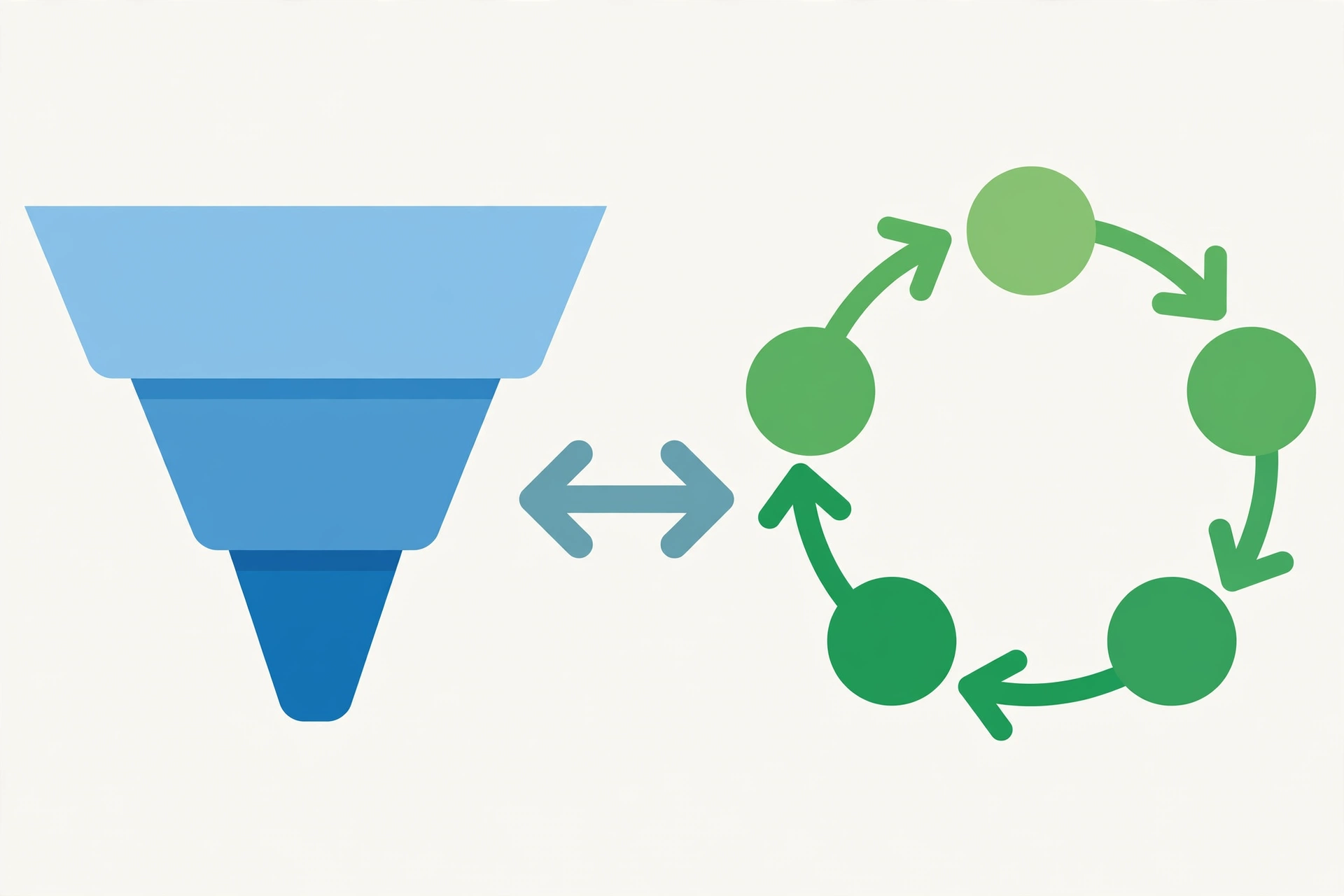
TOFU/MOFU/BOFU vs. AARRR: how the frameworks fit together
Two frameworks get cited constantly, and beginners treat them as rivals. They’re complements:
- TOFU/MOFU/BOFU (top/middle/bottom of funnel) describes buyer awareness — what the prospect knows and needs at each point. Use it to plan content and messaging.
- AARRR (Acquisition, Activation, Retention, Referral, Revenue — “pirate metrics”) describes what happens inside your product and business after someone arrives. Use it to measure and optimize.
The practical combo for 2026: run TOFU/MOFU/BOFU to attract the right people, then run AARRR to track everything after signup. Most SaaS companies are decent at the first and blind on the second — which is exactly why retention leaks go unnoticed for quarters.
AI changed the funnel in 2026 — here’s what to do about it
A growing share of buyer research now happens inside AI answer engines — ChatGPT, Perplexity, and Google’s AI overviews answer the buyer’s question directly, often without a click to your site. Research cited across 2026 marketing guides notes that only a small fraction of URLs cited by AI tools overlap with Google’s top 10; the rest come from Reddit threads, review sites, and comparison posts.
What this means for your funnel, practically:
- Write to be cited, not just ranked. Clear definitions, concrete numbers, and direct answers (“what is X?”, “how much does Y cost?”) are what answer engines quote. This post’s structure is deliberate that way.
- Show up where AI looks. Genuine participation in Reddit, Indie Hackers, and niche communities now feeds the top of your funnel indirectly — through citations you can’t buy.
- Use AI inside the funnel, surgically. The highest-ROI uses aren’t chatbots on your homepage — they’re AI at the exact drop-off points: instant lead qualification, smart follow-up timing, and pricing-page assistance where hesitation happens.
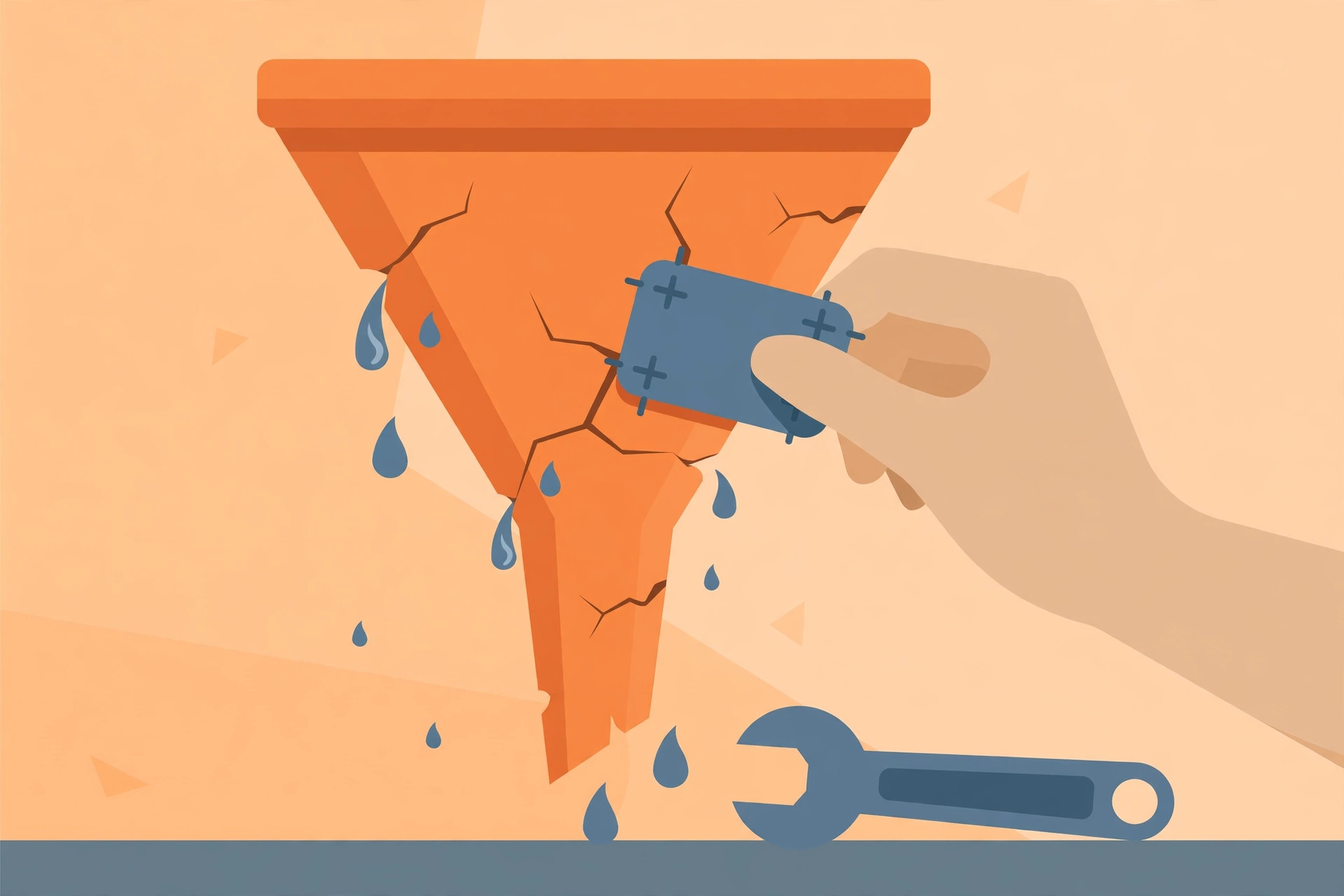
The 5 most common funnel leaks (and fixes)
Leak 1: Traffic that never engages. Thousands of visitors, no signups. Fix: your content attracts the wrong intent. Shift 20% of content budget from broad thought-leadership to problem-specific how-tos with a relevant lead magnet.
Leak 2: Trials that never activate. Signups spike, then silence. Fix: shorten time-to-value ruthlessly. The best onboarding gets a new user to their first “aha” in under 5 minutes — templates, sample data, and guided setup beat feature tours.
Leak 3: Paywall sticker shock. Trial users vanish at pricing. Fix: audit pricing-page clarity before discounting. Most “too expensive” objections are actually “I don’t understand what I’m buying” objections.
Leak 4: Silent churn at month 3. Logins fade, then cancellation. Fix: instrument usage drop-offs and trigger human check-ins before the renewal date, not after the churn email.
Leak 5: No expansion motion. Customers stay but never grow. Fix: tie expansion prompts to usage milestones, not sales quarters. Value-triggered upsells feel like help; calendar-triggered ones feel like pressure.
A worked example: Texas SaaS founder
Take Daniel, who runs a 12-person scheduling SaaS in Austin. His funnel audit found: plenty of top-of-funnel traffic from SEO (awareness ✓), a 1.1% visitor-to-trial rate (engagement ✗ — industry content was attracting students, not buyers), and a 9% trial-to-paid rate (conversion ✗ — pricing page confused annual vs. monthly). He fixed intent targeting (rewrote 10 posts for buyer keywords), simplified pricing to two tiers, and added a 5-minute onboarding checklist. Six months later: visitor-to-trial at 2.8%, trial-to-paid at 19% — without spending a dollar more on ads. The lesson: fix the weakest stage first, then move downstream. Don’t optimize everything at once.
Mapping the two frameworks: a quick reference
| Funnel layer | TOFU/MOFU/BOFU lens (buyer awareness) | AARRR lens (business action) |
|---|---|---|
| Awareness | TOFU — buyer learns the problem exists | Acquisition — they arrive via a channel |
| Engagement | TOFU/MOFU — buyer interacts with your thinking | Acquisition — they become a known lead |
| Consideration | MOFU — buyer compares solutions | Activation setup — trial/demo begins |
| Conversion | BOFU — buyer decides | Activation + Revenue — first value, first payment |
| Retention | Post-funnel (often ignored) | Retention — the core SaaS metric |
| Expansion | Post-funnel | Revenue — NRR growth |
| Advocacy | Post-funnel | Referral — new acquisition loop |
Notice the loop at the bottom: advocacy feeds back into acquisition. That’s the compounding effect SaaS companies chase — each retained, expanded customer makes the next customer’s acquisition cheaper.
Your 30-day funnel fix plan
Don’t rebuild everything. Run this sequence:
Week 1 — Measure. Instrument the 7 stages with one metric each (use the table above). You can’t fix what you can’t see; most teams discover they’ve been flying blind below the trial line.
Week 2 — Find the weakest stage. Compare each metric against the healthy ranges. The stage furthest below benchmark is your project. Ignore everything else for now.
Week 3 — Fix one leak. Pick the single highest-impact fix for that stage (examples: a 5-minute onboarding checklist for activation, a pricing-page rewrite for conversion, a 45-day usage check-in for retention). Ship it.
Week 4 — Verify, then move downstream. Give the fix two weeks of data. If the metric moved, lock it in and attack the next-weakest stage. Funnel optimization is sequential, not parallel — that’s what makes it compounding rather than chaotic.
Is a SaaS marketing funnel the same as a sales funnel?
No. A sales funnel typically ends when the deal closes. A SaaS marketing funnel continues through retention, expansion, and advocacy — because in subscriptions, most lifetime value arrives after the first sale. Companies that run a pure sales funnel on a SaaS product systematically underinvest in the stages that determine profitability.
Tools that power each funnel stage
You don’t need a 20-tool stack. One solid tool per stage beats five overlapping ones:
- Awareness: an SEO/content engine (WordPress + Google Search Console for measurement) and a community presence where your buyers actually hang out.
- Engagement: an email capture and nurture tool — Brevo or Mailchimp on their free tiers handle the first few thousand subscribers at $0.
- Consideration: a demo/trial platform with analytics — Mixpanel or Amplitude for product analytics, Calendly for demo booking.
- Conversion: a billing system that doesn’t leak — Stripe Billing or Paddle, plus a pricing page you A/B test quarterly.
- Retention: lifecycle email (Customer.io, Intercom) and in-app guides (Appcues, Userpilot) triggered by usage data, not calendars.
- Expansion: usage metering in your billing tool plus a CRM (HubSpot’s free tier) to track account health.
- Advocacy: a review engine — automated post-milestone asks pushing to G2/Capterra, plus a simple referral program (ReferralCandy, or built in-house).
The pattern: each stage gets one owner and one metric. Tool sprawl is how funnels become unmeasurable.
Frequently asked questions
What is a SaaS marketing funnel?
A SaaS marketing funnel is a framework mapping the buyer journey from discovery to purchase — plus the post-purchase stages (retention, expansion, advocacy) that subscription revenue depends on. Unlike traditional funnels that end at conversion, the SaaS version treats closing the sale as the starting line.
How is a SaaS funnel different from a regular sales funnel?
Three differences: retention is a core stage (not an afterthought), free trials/freemium create an “activation” moment in the middle, and the journey is non-linear — buyers loop between stages rather than flowing straight down.
What are the stages of a SaaS marketing funnel?
The full model has 7 stages: awareness, engagement, consideration, conversion, retention, expansion, and advocacy. Simpler versions collapse these into four: top, middle, bottom, and retention.
What metrics should I track at each funnel stage?
Awareness: qualified traffic. Engagement: lead conversion rate (2–5%). Consideration: demo/trial requests. Conversion: trial-to-paid rate (15–25% for self-serve). Retention: net revenue retention (100%+). Expansion: expansion MRR share. Advocacy: referral signups.
What is the biggest mistake in SaaS funnels?
Optimizing for signups while ignoring activation and retention. A funnel that converts well but churns in month three is a leaky bucket — fixing the weakest downstream stage usually beats adding more top-of-funnel traffic.
How does AI affect SaaS marketing funnels in 2026?
Two ways: buyers increasingly research inside AI answer engines (so write citable, direct answers and participate in communities AI quotes), and AI works best surgically at drop-off points — lead qualification, follow-up timing, pricing-page assistance.
Do I need separate funnels for self-serve and sales-led SaaS?
The stages are the same, but the tactics differ. Self-serve funnels lean on onboarding UX and in-app triggers; sales-led funnels lean on SDR outreach, demos, and multi-stakeholder content. Map the same 7 stages, then fill each with motion-appropriate tactics.
The bottom line
A SaaS marketing funnel isn’t a prettier version of a sales funnel — it’s a different machine built for recurring revenue. The companies that win treat conversion as the midpoint: they instrument every stage, fix the weakest one first, and remember that in subscriptions, the sale is just the starting line. Audit your funnel this week against the 7 stages above. You’ll find your biggest leak in under an hour — and fixing it will beat any new traffic campaign you could run.
Keep going: SaaS Marketing Strategy 2026 — the full channel-by-channel playbook with a $2,000/month budget plan.